
Exit interviews or stay interviews: what each tells you
An exit interview tells you why someone left. A stay interview asks what would keep them. Each is useful, as long as you are clear what it can and cannot tell you.

In this article
Imagine this: A senior associate leaves for a rival firm. In her exit interview she is warm and positive, and mentions “a great opportunity”. Six months later, two more associates from the same team leave, using almost the same words.
None of those conversations were wrong. Read one at a time, they said very little. The useful question is what each kind of conversation can reasonably tell you, and when to use it.
What an exit interview can tell you
An exit interview happens once someone has decided to go. That is its strength and its limit. People who have resigned may feel freer to say what they think, and across several leavers a pattern can appear that no single conversation shows.
The limits are practical. The decision has been made, so the conversation explains it rather than informs it. Leavers may still want a reference, and in a small team or a partner-led practice they may know exactly who will read their comments. Many are never asked. In a 2023 survey of UK leavers by recruiter Cpl, reported by People Management, 55% said they had not been invited to a formal leaving interview. More than a quarter believed their input would have no impact.
Writing in Harvard Business Review, Everett Spain and Boris Groysberg argue that many exit interview programmes “fail to either improve retention or produce useful information”. They point to “poor data quality and a lack of consensus on best practices”. Two steps help. Ask someone outside the leaver's reporting line to hold the conversation. Then read leavers together, over a year, rather than one at a time.
What a stay interview can tell you
A stay interview asks people who are still with you what keeps them, what gets in the way and what might change their mind. It happens while there is still time to respond.
That conversation is rarer than it sounds. Gallup's US research found that even among recent leavers who had spoken with a manager or leader before going, only 17% had discussed what it would take for them to stay.
Stay interviews have limits of their own. People may not be fully candid with the person who allocates their work or decides their progression. You hear only from the people you choose to ask. And asking creates an expectation: if someone explains what would help and nothing follows, they may be less willing to say anything next time. Evidence on whether stay interviews reduce turnover is still limited. Treat them as a way to hear more, not as a retention guarantee.
Exit and stay interviews side by side
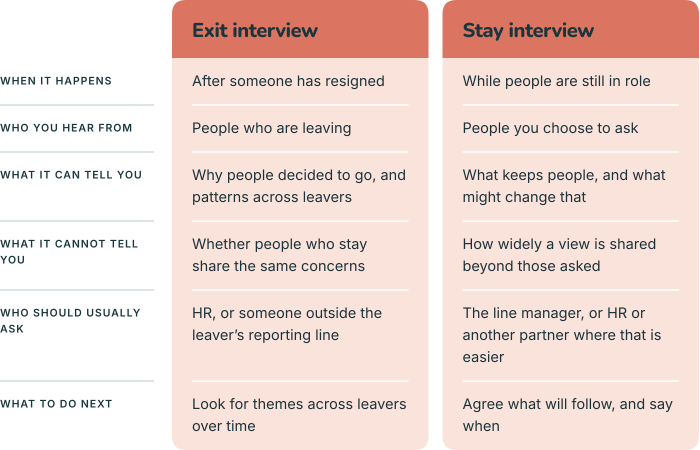
Used together, they answer different questions.
Imagine an accountancy practice reviews a year of exit notes and sees development mentioned again and again. Before the next promotion round, managers hold short stay conversations with senior staff about how they see the next two years.
The exit notes pointed to a theme. The stay conversations test whether it is still live.
Make either conversation worth having
- Purpose: say why you are asking, and that this is not a performance review.
- Who asks: choose someone the person can speak to openly, which is not always their line manager.
- Visibility: tell people who will see what they say and how it will be used.
- Record: note themes in people's own words, not as scores or ratings.
- Follow-up: say what will happen next and when, including what cannot change.
For a stay conversation, a few open questions are enough: “What keeps you here?”, “What would make your work better over the next six months?” and “Is there anything that has made you think about leaving?”.
Where a regular measure fits
Both methods are heard from individuals. On their own, neither shows whether what you heard is isolated or shared, or whether it is changing over time.
That is the job of a regular, consistent question asked across the organisation. In EHS, the same question is asked in a quarterly rhythm, as The EHS Method explains. Focused Check-ins can explore a separate question between Cycles. They do not update the headline score. Templates such as Manager support or Performance & growth can test a theme from exit or stay conversations across a whole team, not just a few people.
A Check-in does not replace a conversation. It helps you see where a conversation is most needed. The organisation still owns the interpretation, decisions and communication.
Keep the exit interview. Ask the stay question while there is still time to act on the answer.
An exit interview explains a decision. An earlier conversation can still inform one.